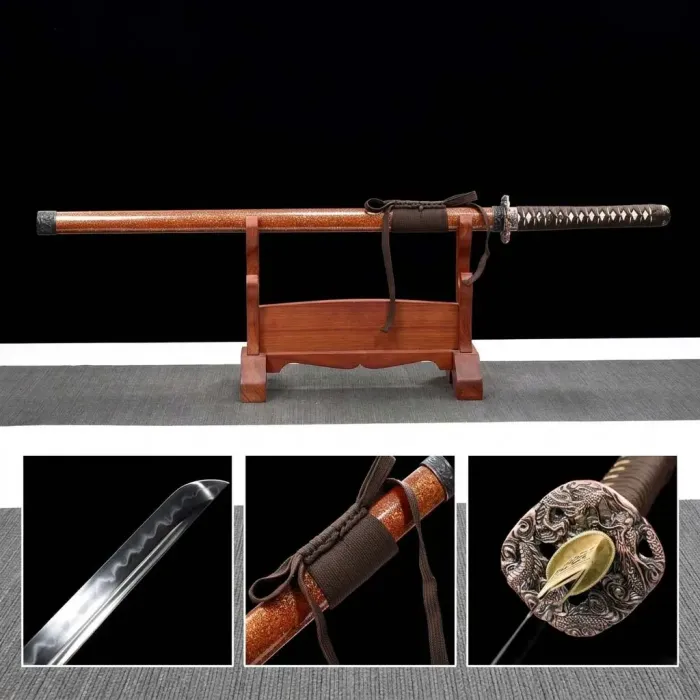
This conventional eastern blade serves as a impressive example of fabrication, but suppose you long for to reveal your particular aesthetic? Tailoring your blade is a enriching journey, allowing you to forge a truly rare piece. From the handle wrapping and clasp to the tsuba design and tempering curve, each element offers a chance for tailored look. This investigation delves into the sphere of katana modifications, providing guidance for both learners and seasoned enthusiasts aiming to inscribe their impression on the age-old art of the samurai.
Introductory Real Skill
For aspirants hoping to embark on the satisfying journey of martial arts involving swords , 1060 steel katanas supply an remarkable entry point. This specific grade of tool steel balances a suitable blend between price and efficiency . While below hard as supreme steels, 1060 allows for a workable level of knife work , making it suited for initiates to learn the core principles of edge management and embrace the refinement of expertly made Japanese weaponry. It’s a outstanding choice for building experience without the budgetary burden of more sophisticated steels.
T-10 Steel Blades : Striking Capability and Budget
Enabling fans seeking an authentic weapon experience without overpowering the cash reserve , T10 substance katanas represent a beneficial option. These instruments offer a distinct improvement in strength compared to substandard alternatives, exhibiting respectable edge retention and enough flexibility for simple chopping techniques. While not rivaling the exceptional characteristics of higher-grade steels like T100 or folded compound, T10 provides a effective blend of capacity and reasonableness , making them a trendy choice for novices and those on a tight salary .
Overcoming the Cutting Surface : Modifying Your Sword's Attachments and Grasp
Whereas the refined edge is undeniably the essential point of a katana, truly boosting its appeal lies in the thoughtful customization of its fittings and haft . This procedure allows enthusiasts to present their one-of-a-kind preference . Consider the ample possibilities: menuki - decorative charms that introduce visual attraction ; the hamon wrappings – often elaborately chiseled; the tsuka foundation itself, wrapped in customary ito braid ; and the fusa finial , which can be fashioned from various fabrications like ornaments or bone .
- Decide on styles that match with you.
- Test with distinctive elements .
- Prioritize superiority for a lasting influence .
The Magnetism of the Katana: Background, Fabrication, and Iron
The samurai blade shows a distinctive allure, steeped in eras of Japanese history and legacy . More than merely a contraption of battle , it's a token of the fighter class ethos – a fusion of mastery and governance . Its unfolding spanned numerous generations, with early cutting instruments evolving into the slender curvature and lethal edge we perceive today. The production involved is truly remarkable , requiring lifetimes of education to achieve . The process involves a complex folding of forged iron , creating layers that reinforce the instrument’s flexibility and slicing ability. Diverse schools of crafting came about , each with their own secrets and methods for achieving the perfect symmetry and definition - a truly challenging pursuit.
- Preliminary Katana forms
- The purpose of the samurai blade in fighter class culture
- Time-honored manufacturing procedures
Identifying the Fitting Steel for Your Katana Project: 1060 vs. T10
Selecting the right steel is critically important for any blade project, and the selection between 1060 and T10 can be challenging. 1060 is a widely used American alloy, offering a reasonable balance of durability and robustness, providing wakizashi it fairly easy to temper. However, T10, a originating from Japan steel, usually boasts superior wear resistance and can perhaps achieve a amplified end hardness, although it can be considerably hard to operate and requires exact heat conditioning. Consider your expertise and intended goals: for a trainee, 1060 may be a more straightforward launchpad, while the seasoned smith might seek the extra merits of T10.
- User-friendliness of Controlling
- Corrosion
- Peak Hardness
Unleashing the Power: High-Level Katana Modification Methods
Becoming proficient in blade modification extends far beyond basic grinding. Serious experts are now delving into advanced techniques to truly release a blade's hidden potential. This features intricate work with the temper line, utilizing specialized compositions for differential strengthening and carefully choosing the outline of the protector to optimize balance and performance. Beyond purely functional customizations, artisans are increasingly focused on producing unparalleled aesthetic splendor, through complex imprinting and layered coatings that truly transform a katana into a artistic composition.
From Ordinary Steel to Fine Blade: Fabricating a 1060 Katana
The journey commences with conventional 1060 alloy , a robust material far removed the ornate katana it will turn into . Skilled bladesmiths practice a multifaceted process of doubling and constructing the unrefined steel, repeatedly tempering it and beating it to separate impurities and produce a homogeneous grain structure. This tedious process, often continuing for spans , builds the essential hardness and flexibility characteristic of a real Japanese edge . Additional heat applications , including methodical hardening and annealing , are necessary to achieve the aimed equilibrium of sharpness, endurance and splendor .- Folding: Eliminates impurities and produces grain structure.
- Constructing: Forms the steel into the initial blade form.
- Quenching: Controls the final hardness and flexibility.
The Continuing Pull of the Katana: Comprehensive Review of Metalwork and Tailoring
Such established katana stays a captivating symbol representing Japanese custom , its enticement far beating mere combat tools . Forged from unique steel and commonly featuring intricate motifs , the procedure of creation itself is a honored art. Beyond the central craftsmanship, the ability to refine a katana - from the hamon to the tsuka wrapping and collar - enables for a genuinely individual embodiment for both fans and carriers alike. This integration of long-established steelwork and boundless personalization causes the katana's continued renown across the earth .
